
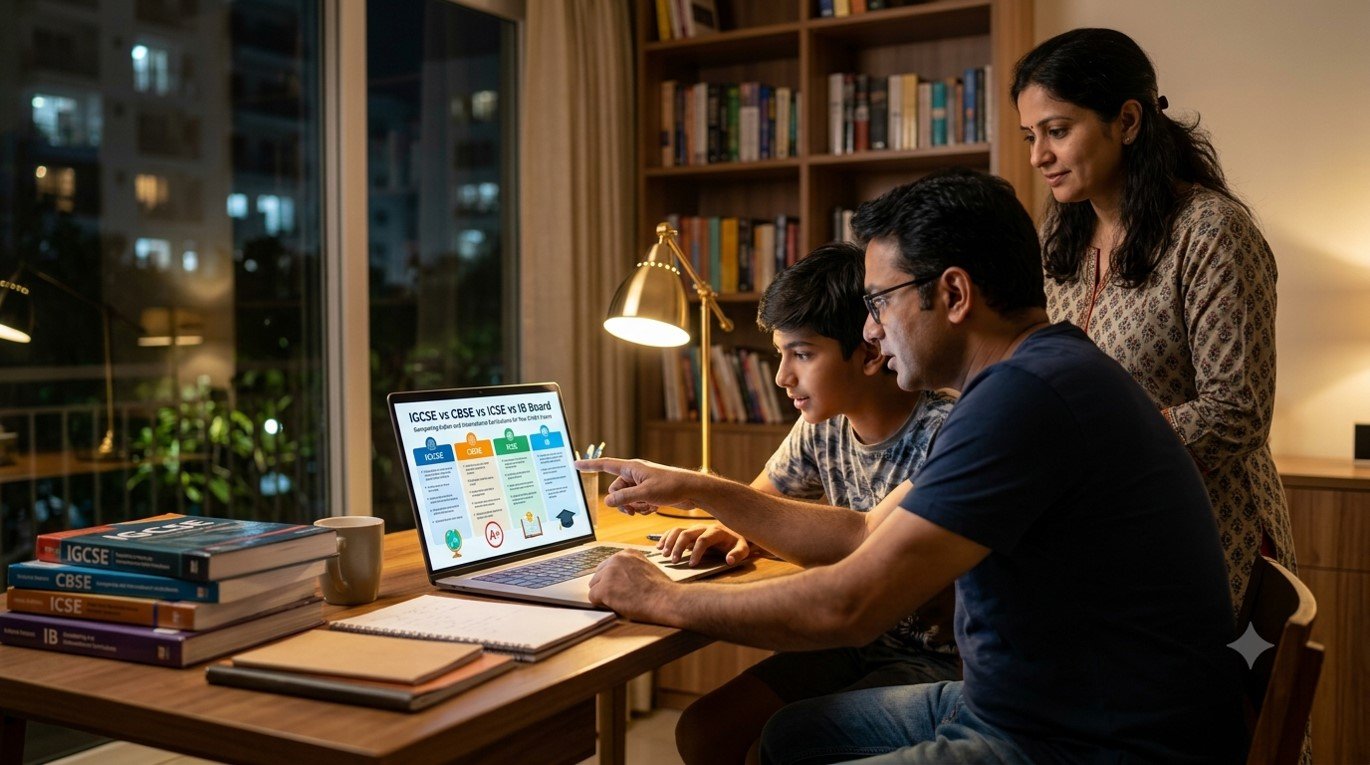
Which school board would be best for your child?
There's no universally best board — only the board that fits your child's goals, learning style, and your family's budget and mobility plans. Here's a straightforward comparison, without the marketing gloss.
CBSE (Central Board of Secondary Education) is India's most widely used national board, built around a syllabus closely aligned with JEE and NEET preparation.
ICSE (Indian Certificate of Secondary Education) & ISC (Indian School Certificate), run by CISCE, is known for a broader curriculum, in-depth understanding and strong English-language emphasis.
IGCSE (International General Certificate of Secondary Education), a Cambridge International qualification, is internationally recognized and flexible but doesn't by itself guarantee Indian university admission.
IB (International Baccalaureate) offers the strongest global university recognition and genuine skill-building, at a significantly higher cost and workload.
State Board or PUC (Pre University College) is offered only for Class 11 & 12, by the boards of varying individual states. Each state has their own board and examination and marking system.

What are the honest trade-offs of each board?
CBSE aligns directly with India's competitive entrance exams, but it leans exam-heavy and rote-oriented in practice.
CISCE (ICSE & ISC) offers strong depth and understanding of subjects, high level English and a broad syllabus, the workload is heavy and the school network is smaller nationally.
IGCSE is flexible and globally portable, but it creates real gaps for JEE/NEET preparation and doesn't independently secure an Indian university seat.
IB delivers the best global recognition and genuinely develops independent thinking, but the workload, fees, and lack of JEE/NEET alignment are real constraints, not footnotes.
State Board is the most affordable option and comparatively easier to score in, but it leans on rote-oriented in practice.
How should a family actually decide?
Start with where your child is likely to study for undergraduate education — India or abroad.
Then look at the career direction that's emerging- engineering or medicine point toward CBSE/ICSE/ISC; humanities or global academia point toward IB or IGCSE.
Layer in what you can realistically afford over ten-plus years, not just this year. Finally, be honest about whether your child has a strong and structured memory retention, who thrives with clear syllabi, or an independent thinker who does better with open-ended assessment. Match the board to these answers, not to the board's reputation.
Frequently Asked Questions
Can an IB or IGCSE student still get into IITs?
Yes, through JEE/NEET like any other student — but the syllabus doesn't prepare them directly, so additional coaching is usually necessary.
Is IB worth the extra cost?
Only if your child genuinely targets global universities and has the stamina for a demanding, research-heavy workload. For an India-only career path, it's rarely the most efficient choice.
Is it too late to switch boards in Class 9?
Switching becomes considerably harder after Class 9. Class 7–8 is a more forgiving window if a change is genuinely needed.
................................................................................................................................................
The takeaway: The costliest mistake parents make is choosing a board for prestige rather than fit. Decide based on your child's goals and learning style — not the brand name on the school gate.